The scientific community has a plan for achieving fusion power. It involves getting a better understanding of how to control fusion in a tokamak-style reactor using the currently under construction ITER reactor, and then using that knowledge to build DEMO-style plants. But ITER isn't even expected to see hot plasmas until the middle of the 2030s, by which point solar panels will be so cheap that we'll probably all be getting them free in our cereal boxes.
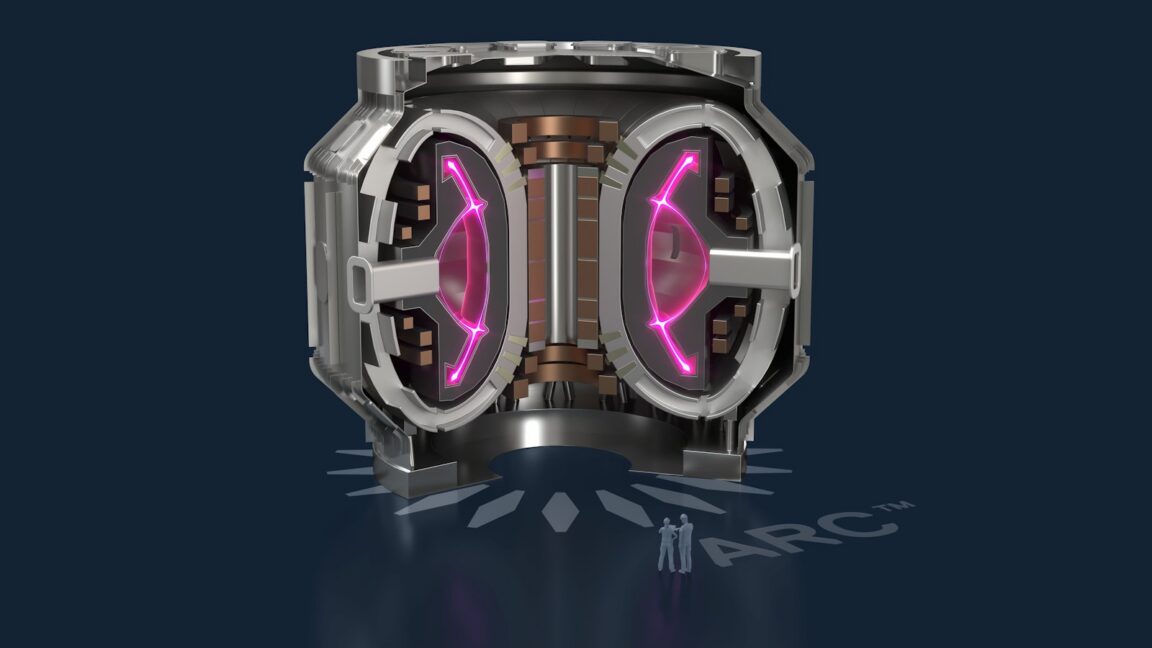
Commonwealth Fusion is a startup that's basically asking "what if we did that, but now?" Its ITER equivalent, a tokamak called SPARC, is over 70 percent complete and is planned to be operating as soon as next year. The company already has a site and customers for the power-generating follow-on, called ARC. Both of those projects are predicated on using high-temperature superconductors to generate an extremely powerful magnetic field that will allow the company to build a smaller reactor, and thus get things done faster.
Years of running plasmas through tokamaks has given us confidence that the basics of these plans are sound. But there are lots of potential devils in the details (otherwise there'd be little need for experimental reactors). So Commonwealth's scientists, in collaboration with the academic community, have recently released five peer-reviewed papers that detail its plans for ARC: what our best models tell us now, and what we'll still need to learn from SPARC to finalize the design of a production fusion plant.
The basics of ARC
The articles are all published in the Journal of Plasma Physics—they're open access, so you can view them yourself, but they are long (roughly 30–40 page PDFs) and highly technical. What follows is an overview of some of what's there and a few things that stood out to me as I went through them.
ARC will be a tokamak that hosts fusion between hydrogen's two heavier isotopes, deuterium and tritium. This reaction results in a helium nucleus and releases a neutron and radiation. The helium transfers heat to the plasma, maintaining the conditions needed for fusion, but it is otherwise a waste product, referred to as "ash" in the fusion context. The neutron and radiation, however, are put to use.
Part of that use is simply imparting energy into a blanket of molten salt that surrounds the fusion chamber. That's energy, in the form of heat, that will be used to drive a turbine that produces the electricity. The molten salt includes lithium ions; when one lithium isotope absorbs a neutron, it decays into more helium, plus a tritium that can be used as fuel for the reactor. There are isotopes present that will also release additional neutrons, allowing this process to generate sufficient fuel.
Overall, the present design of ARC is expected to produce about 1.13 GW of fusion power, with 500 MW of that extracted as electricity. Some of that (100 MW) will be needed to power the plant's operations, leaving 400 MW to be sent to the grid.
The rest of the energy is either kept in the tokamak to maintain the fusion reactions or lost due to inefficiencies in the heat and energy transfer of the system. There's a lot of uncertainty about these numbers; the 1.13 GW is just the center of a range of potential values running from 900 MW to 1.3 GW, so the 400 GW output may need to be adjusted up or down accordingly.
Some of that 400 MW comes during periods where fusion is not occurring. The nuclear reactions will occur within 15-minute-long periods that will be interspersed with one minute resets. The resets are meant to be kept short enough that nothing has much of a chance to cool down before it gets heated up again—thermal inertia will let it continue generating power. That will be one of the key differentiators with SPARC, which doesn't have the heat extraction needed to maintain stable fusion for these long time periods, and so can't maintain the near constant temperatures needed for reliable power generation.
It's inevitable that parts of the device will be exposed to radiation and perhaps fusion plasma. The inner walls of the reactor will be shielded by tungsten, which will limit erosion by the conditions. Meanwhile, the vacuum vessel is designed to be replaced every one to two years. The papers note that this flexibility will allow them to make some design changes even after ARC is built. To enable this, the whole tokamak is meant to split in halves for maintenance.
Instabilities
The two big uncertainties in the operations of ARC are long-standing challenges for fusion: how to handle magnetic instabilities, and how to handle the helium ash and material that escapes the magnetic containment.
Some of the latter will simply be handled by the resets that happen after every 15 minutes of operation, which will clear the reaction chamber and add fresh fuel. But during operations, this will be handled by what's called a divertor, an area where the magnetic field lines are shaped to allow some material out of confinement.
"To maximise ARC’s fusion power output while avoiding excessive erosion of the plasma-facing components, we will need to radiatively dissipate most of the power crossing the last-closed flux surface, injecting radiating impurities such as argon or neon to access divertor detachment," one of the papers says. "Divertor detachment will need to be integrated with a high-performance core plasma, and with efficient impurity pumping to prevent the accumulation of helium ash in the core."
The models they use predict that the system will keep enough pressure at the diverter to spit out enough of the helium ash to keep it from interfering with the fusion reactions. But that prediction will need to be tested empirically.
Magnetic instabilities can lead to a rapid loss of control of the plasma, potentially leading energetic, charged particles to slam into the reactor walls. The tungsten limits the damage and protects the more sensitive hardware, but will be eroded, and the tungsten that is eroded off can stay in the chamber and contaminate further runs of the system.
A lot of work has gone into designing systems that control the magnetic fields containing the plasma, trying to find sensor readings that presage instabilities and choosing adjustments that can suppress them. (This is something that AI-based systems may be useful for.) Commonwealth definitely plans to block as many instabilities as possible. But it's also being realistic and expecting that some will inevitably happen. So, it's planning to simply quench the system with as little damage as possible and restart as quickly as possible in order to not let the heat extraction system cool down significantly. In essence, the idea is to swiftly get the system into the state it's normally in during the minute-long resets that are part of its typical operations.
One of the risks during the instabilities are runaway electrons, which accelerate to relativistic energies and can slam into the walls of the reaction chamber. These may be easy enough to handle with a carefully located wire within the reactor that can convert the electrons to current that can be extracted. But Commonwealth doesn't plan to install one of them until it is clear that this is a significant problem: "SPARC will explore operation... which will provide the data on whether dedicated runaway electron mitigation systems are necessary in ARC."
Far more problematic is the loss of the containment of the heavier particles in the plasma, which are capable of causing more significant erosion. The idea here is to cool the system to lower energies as quickly as possible while keeping the material from running into the wall. So, ARC will contain multiple locations where the controller can inject neon into the reaction chamber in order to handle both issues.
Physics vs. finance
There is obviously a lot more that the Commonwealth team is worried about than what stood out to me. One of the papers had a "non-exhaustive" list of physics issues that SPARC would help them sort out, and it was 18 items long. And, while that will limit the unanswered questions relevant to ARC, the construction of ARC is planned to overlap with the experiments in SPARC, so it's possible there will be some last-minute scrambling needed to adjust ARC's design while it's in progress.
But overall, the peer-reviewed papers make a strong case that, as Commonwealth's chief scientific officer, Brandon Sorbom, put it, "When we build the ARC Fusion Power Plant, it will work." According to our best models, developed using real-world data from multiple tokamaks, ARC should be able to regularly trigger fusion reactions that release more energy than we put into them.
But there's "working" from a physics perspective, and "working" from a market perspective. For this to work as planned, that fusion would have to be sustained for 15-minute periods and suffer very few instabilities over the course of the day to keep everything hot enough to work. And servicing activities like replacing the vacuum container will have to be done quickly enough so that the plant isn't offline for long periods.
Plus there's the financial issues of the large up-front cost for the sophisticated hardware and support infrastructure, as well as the highly technical staff needed to run this sort of facility. One of its major selling points is that it should provide around-the-clock energy without the need for some separate form of storage, but right now, grid operators don't provide much in the way of financial incentives for that sort of reliability. So, Commonwealth will find itself competing with some very cheap forms of generation for parts of the day.
All of which is to say that ARC could work from a physical perspective and still ultimately fail when it starts producing power. Sorbom said the company had run the numbers under a range of assumptions and found that ARC made sense. But the finances are going to be the hardest risk to retire and may require having ARC operate for decades before we have a definitive answer.
Read full article
Comments
 Log in